Why SEO-Optimized Frontend Architecture Matters for Modern Ecommerce Brands

Author
Parth ChopraPublished
May 13, 2026Reading Time
15 min read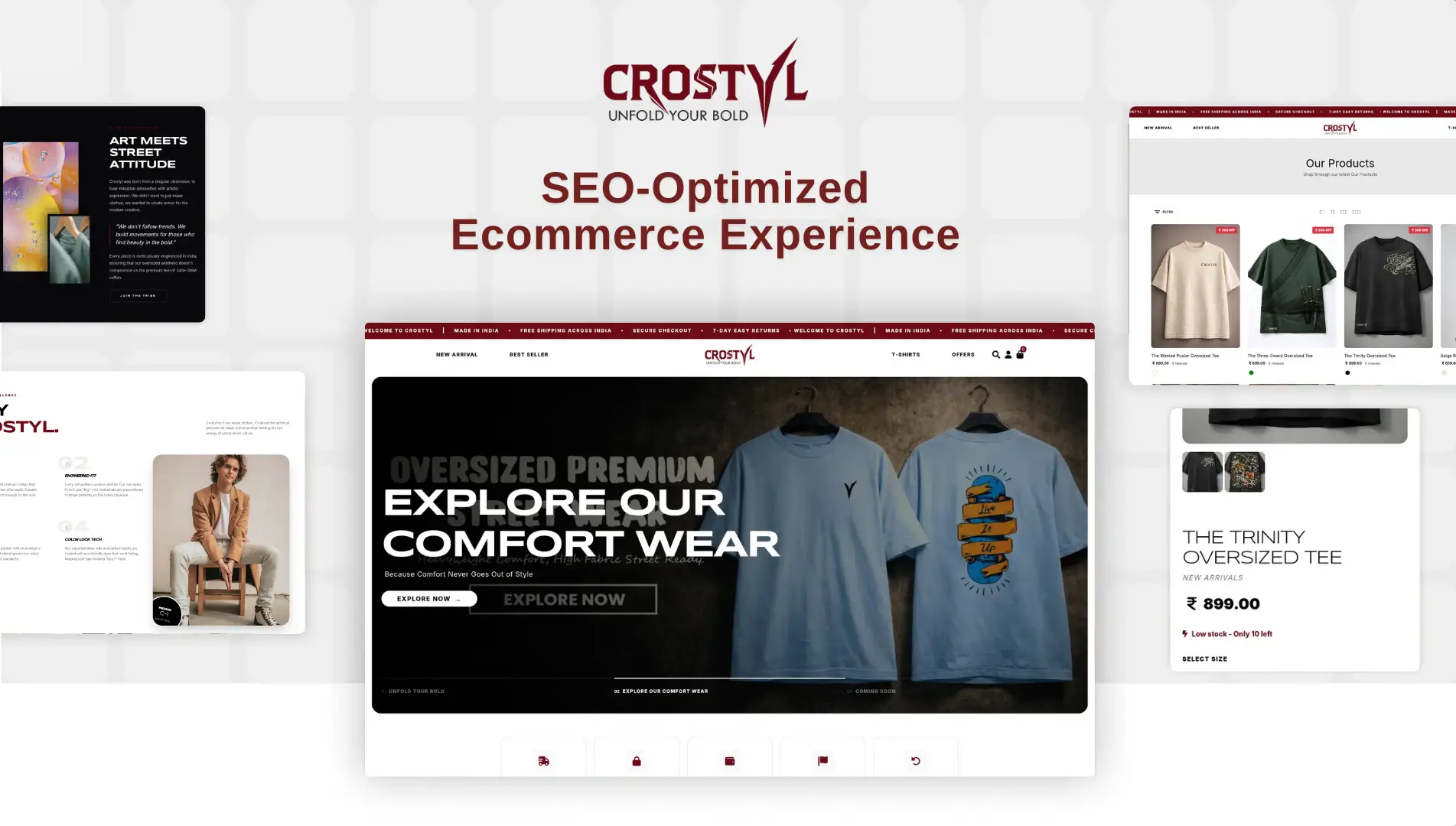
Introduction
Modern ecommerce competition is no longer defined only by product range, pricing, or paid traffic. Customers now compare digital storefronts with the same instinct they use to compare physical retail spaces: how quickly the experience responds, how clearly the product is presented, how trustworthy the interface feels, and whether the brand experience is memorable enough to return to. For fashion and lifestyle brands, this expectation is even sharper. The storefront has to sell the product, but it also has to communicate taste, quality, confidence, and cultural positioning.
This is why ecommerce frontend architecture has become a core growth system. A storefront is not just a set of pages connected to a checkout. It is a distributed interface that shapes search visibility, conversion behavior, mobile engagement, product discovery, and customer trust. The best ecommerce platforms treat frontend engineering, SEO, design systems, media workflows, and backend commerce APIs as one connected product system.
Crostyl was built from that perspective. The goal was not to create a standard product grid with a checkout path. The goal was to translate a premium streetwear identity into a scalable digital commerce experience using a headless ecommerce React Django architecture, SEO-aware frontend structures, mobile-first interactions, and immersive product presentation.
Beyond Beautiful UI
Beautiful interface design matters, but aesthetics alone do not create ecommerce performance. A visually rich store can still fail if pages load slowly, metadata is incomplete, mobile interactions feel heavy, product media shifts during rendering, or search crawlers cannot clearly understand page structure. Premium ecommerce frontend work requires balancing emotion with engineering discipline.
Discoverability is one of the biggest reasons. A product page that looks strong to a human user may still underperform if headings are poorly structured, critical content is hidden behind brittle client-side behavior, product information is not semantically organized, and metadata does not communicate the right intent. For an SEO ecommerce platform, frontend architecture determines whether the storefront can be found before it can persuade anyone to buy.
Performance also changes conversion psychology. Users read speed as quality. When product images load predictably, transitions feel smooth, and touch interactions respond immediately, the brand feels more reliable. When layout shifts, delayed scripts, or oversized media interrupt browsing, the experience feels less premium even if the visual design is polished. In ecommerce, perceived performance and perceived trust are closely connected.
This relationship is especially important in fashion ecommerce UI. Customers are browsing visually. They compare silhouettes, color, texture, styling, and brand signals quickly. The interface must support that behavior with sharp galleries, clean product hierarchy, responsive product cards, and fast transitions. Every delay or unstable layout interrupts the emotional momentum that drives exploration.
SEO Is Frontend Architecture
The phrase SEO optimized ecommerce often gets reduced to keywords, blog content, and metadata. Those pieces matter, but technical discoverability begins much deeper in the frontend. Search visibility is shaped by how pages render, how content is structured, how mobile layouts behave, how assets load, and how stable the user experience remains during interaction.
Semantic HTML is the foundation. Product pages need meaningful headings, descriptive product names, accessible image alternatives, structured sections, and content hierarchy that reflects the page intent. Navigation should expose important categories clearly. Product lists should be readable as real content, not only as decorative interface fragments. These details help search systems and assistive technologies understand the storefront.
Rendering structure is equally important. A React ecommerce frontend can deliver rich interactions, but it must be planned carefully so meaningful content is available reliably. If the storefront depends on delayed client-side requests for every critical product detail, discoverability can suffer. Frontend engineering decisions around routing, data hydration, loading states, and error states directly influence crawlability and user experience.
Metadata handling should be designed as a system, not a last-minute checklist. Product titles, descriptions, social previews, canonical routes, category labels, and image metadata all need predictable rules. A scalable ecommerce architecture should make these fields part of the product workflow so search quality improves as the catalog grows instead of degrading over time.
Mobile responsiveness is also an SEO and revenue concern. Search engines evaluate mobile experiences heavily, but customers also make purchase decisions on mobile screens. Responsive rendering must go beyond shrinking desktop layouts. It should reconsider tap targets, gallery gestures, filter placement, checkout friction, sticky actions, content priority, and visual density.
Layout stability is one of the most overlooked frontend SEO factors. Ecommerce pages often contain late-loading images, sliders, recommendation widgets, variant selectors, and animation systems. Without reserved dimensions, caching strategy, and predictable media ratios, the page shifts while the customer is trying to browse. Reduced layout shift improves both perceived quality and measurable page experience.
Page performance completes the loop. Image compression, lazy loading, caching, script control, animation cost, and API response strategy all influence how quickly a customer can evaluate a product. Frontend engineering directly impacts search visibility and ecommerce growth because it controls the surface where users and crawlers experience the brand.
Building Crostyl
Crostyl was designed as a modern headless ecommerce platform using React for the frontend experience and Django with Django REST Framework for backend commerce workflows. This separation allowed the frontend to focus on speed, motion, interaction quality, and SEO-aware structure while the backend handled product inventory, authentication, orders, administration, and API delivery.
The React layer provided the flexibility needed for a premium ecommerce frontend. Product grids, galleries, carousels, animations, navigation flows, and mobile UI states could be engineered as modular interface systems. This made the storefront easier to evolve as brand direction, campaign needs, and product presentation requirements changed.
The Django backend gave the platform a stable commerce foundation. Product data, order workflows, admin operations, and authentication logic could be managed independently of the visual storefront. REST APIs created a clear contract between systems, which made the platform easier to test, deploy, and expand.
This headless ecommerce React Django model also supports future growth. A decoupled backend can serve more than one frontend: a web storefront, campaign microsites, mobile apps, or internal operational dashboards. The architecture gives the brand room to expand without rebuilding the entire commerce stack every time the customer experience changes.
Engineering Immersive Product Experiences
Premium fashion commerce depends on product confidence. Customers want to inspect details, understand fit, compare textures, and feel close to the product before buying. Crostyl approached this through immersive ecommerce experience patterns: 3D product previews, AR-ready model rendering, zoomable high-resolution galleries, animated transitions, scroll-based reveals, and interactive product carousels.
These systems need engineering restraint. A 3D viewer can elevate a product page, but it should not block primary content or delay the buying path. High-resolution galleries communicate quality, but image delivery must adapt to device size and network conditions. Animation can create a premium sense of continuity, but it must preserve responsiveness on mobile devices.
The practical goal was to make interaction feel expensive without making the page heavy. That means reserving layout space, delaying non-critical media, optimizing image formats, controlling animation triggers, and designing fallback states. Immersive UX becomes valuable when it improves product understanding while keeping the storefront fast and stable.
Performance Challenges
Fashion ecommerce brings difficult media constraints. Product photography, campaign images, texture detail, and lifestyle visuals are central to the brand experience, but they can quickly become the biggest performance risk. Oversized images increase load time, unstable galleries create layout shifts, and unoptimized sliders can produce poor mobile rendering.
Crostyl required a media workflow that treated images as frontend infrastructure. Assets needed consistent dimensions, compression targets, responsive delivery rules, and caching behavior. Product galleries needed predictable aspect ratios so the page did not shift as users browsed. Zoom interactions had to preserve detail without forcing every user to download maximum-size assets immediately.
Animation optimization created another set of constraints. Smooth motion depends on careful use of transforms, reduced layout recalculation, and awareness of device capability. Scroll-based effects and transitions should create rhythm, not compete with browsing. Performance-focused animation systems make the interface feel alive while respecting battery, memory, and mobile GPU limits.
Backend communication also shaped performance. Product listing, filtering, authentication, cart behavior, and order workflows depend on clean API contracts. If frontend and backend states drift, ecommerce UX becomes fragile. A scalable ecommerce architecture needs predictable API responses, deployment-aware configuration, and clear error handling across environments.
The Importance of Mobile-First Commerce
Mobile-first ecommerce design is not only a responsive layout requirement. It reflects how customers actually browse fashion products. Many users discover brands through social platforms, open product pages on phones, compare visuals quickly, and return later to complete purchase decisions. The first impression often happens on a small screen under imperfect network conditions.
For Crostyl, mobile UX decisions focused on fast product scanning, clean touch interactions, readable product details, and frictionless movement between discovery and purchase. Product cards need enough visual space to carry the fashion identity. Filters need to stay accessible without crowding the screen. Galleries need swipe behavior that feels native. Calls to action need to remain clear without covering important product imagery.
Touch optimization matters because hesitation compounds. If a carousel misreads gestures, a menu feels crowded, or a product image takes too long to stabilize, the experience loses momentum. Mobile commerce must make browsing feel effortless while still presenting enough detail to support confident decisions.
Key Engineering Lessons
The first lesson from Crostyl is that SEO-aware UI systems matter. Search discoverability is not separate from interface work. It is shaped by semantic content, routing behavior, metadata, mobile rendering, page stability, and performance budgets. SEO is frontend architecture when the storefront depends on frontend systems to communicate product value.
The second lesson is that frontend performance drives conversions. Speed is not only a technical metric. It affects trust, attention, and buying confidence. Customers are more likely to explore when the interface responds immediately and product media feels stable.
The third lesson is that headless commerce improves scalability when the boundary is designed well. Separating frontend and backend systems creates flexibility, but only if APIs are modular, deployment configuration is clear, and data contracts support real product workflows.
The fourth lesson is that immersive UX must remain performant. Premium interactions are valuable only when they improve clarity and engagement. 3D previews, AR-ready assets, galleries, and motion systems should enhance product confidence without sacrificing accessibility, search visibility, or mobile smoothness.
Future Ecommerce Direction
The next generation of premium ecommerce will become more interactive, more personalized, and more operationally connected. AR shopping will help customers understand scale, fit, and product detail before purchase. Interactive commerce experiences will move beyond static product pages toward guided exploration, personalized collections, and context-aware product storytelling.
AI-enhanced recommendations will also become more useful when connected to real browsing behavior, inventory state, and brand logic. The strongest implementations will not feel like generic recommendation widgets. They will feel like intelligent merchandising systems that understand style, availability, customer intent, and campaign priorities.
Realtime inventory systems will matter more as brands blend online drops, limited releases, pop-ups, and fulfillment workflows. Customers expect accurate availability, fast checkout feedback, and clear delivery information. Frontend architecture will need to surface this data without making the experience feel operationally noisy.
For premium brands, the direction is clear: ecommerce platforms must become digital brand systems. They need to combine storytelling, product discovery, commerce infrastructure, search visibility, and performance engineering into one coherent experience.
Conclusion
Crostyl demonstrates how a premium ecommerce platform can move beyond a conventional storefront by treating frontend engineering as a growth layer. The work connects SEO structure, React interface systems, Django-powered commerce workflows, media optimization, mobile-first UX, and immersive product presentation into a scalable digital commerce foundation.
Modern ecommerce success depends on more than products alone — it depends on how performance, discoverability, and digital experience are engineered together.
Explore the Crostyl Case Study
See how these frontend, SEO, and headless ecommerce principles were applied to a premium streetwear commerce platform.
View Crostyl Project